Hyperliquid funding rates determine hourly payments between perpetual traders
Last updated -Hyperliquid funding rates determine hourly payments between long and short perpetual positions. Positive rates make longs pay shorts, while negative rates reverse that direction. Each payment depends on position size, the oracle price and the settled rate, so funding changes the cost of holding exposure.
Changing leverage alone does not change the funding payment when position quantity, oracle price and the settled hourly rate remain equal.
Hourly Payments Between Longs and Shorts
An open perpetual position participates in funding at the hourly settlement boundary, with its side determining the payment direction. These transfers pass between long and short holders, and Hyperliquid collects no fee on the funding payments themselves. Perpetual contracts have no ordinary expiry, so funding creates an incentive for their prices to approach the underlying reference. A positive rate adds a holding cost to a long position and credits a short position. A negative rate reverses those effects. Each perpetual market has its own rate, even when another market tracks the same asset.
Funding settlement changes the account's cash balance without itself buying or selling the underlying asset.
Position Notional, Oracle Price and Margin
Position notional is the value of the underlying quantity represented by a perpetual position at a specified price. Margin is the collateral that supports that exposure. Hyperliquid's oracle supplies the funding reference, while the mark price supports margin calculations, liquidation checks and unrealized profit or loss. An execution price describes a trade fill. These prices can differ because they answer different valuation questions. Calculating funding from the entry price or the current mark can therefore produce a different amount from the protocol's payment. The relevant inputs are the position quantity and oracle value at settlement.
How Is the Hourly Funding Rate Calculated?
The standard hourly funding rate combines an averaged premium with a bounded interest correction, scaled from an eight-hour calculation.
Premium Measurements
The standard premium measures the positive impact-bid excess over the oracle, minus the positive oracle excess over the impact ask. Dividing that difference by the oracle price gives a proportional premium. This calculation uses executable book depth for the contract's specified impact notional. A last-traded price alone does not reproduce it.
Impact Bid
The impact bid is the average execution price for selling the specified impact notional into the book's bids.
Impact Ask
The impact ask is the average execution price for buying the specified impact notional from the book's asks.
Interest Correction
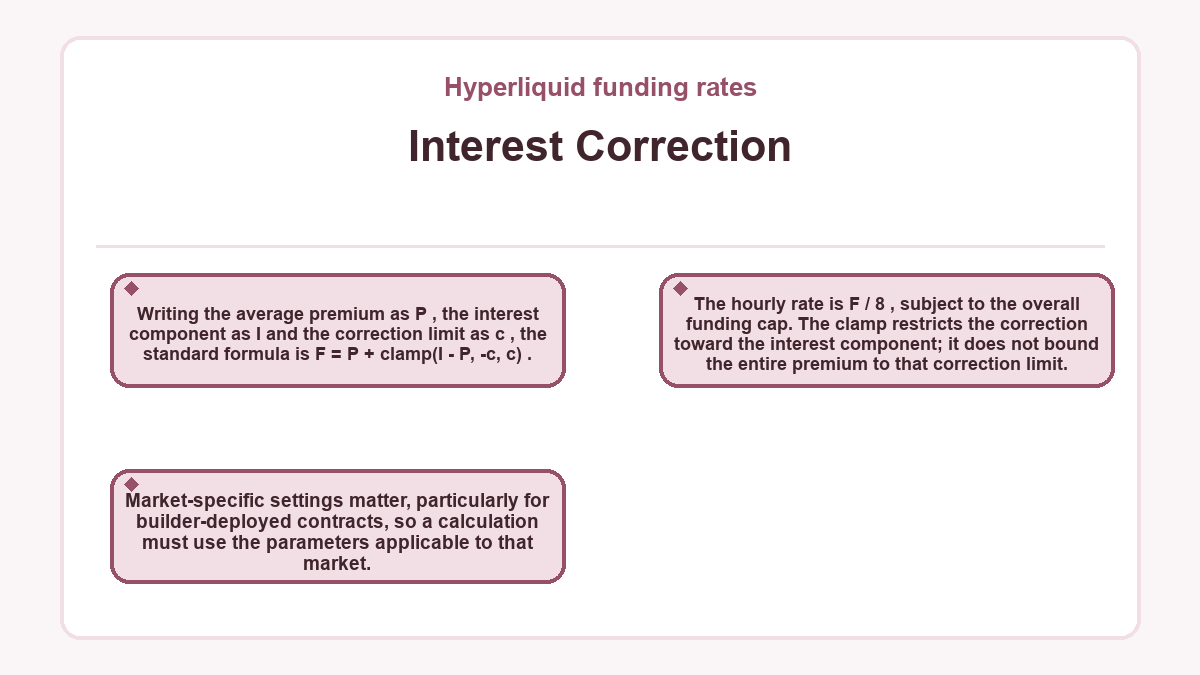
Writing the average premium as
P, the interest component as
I
and the correction limit as
c, the standard formula is
F = P + clamp(I - P, -c, c). The hourly rate is
F / 8, subject to the overall funding cap. The clamp restricts the correction toward the interest component; it does not bound the entire premium to that correction limit. Market-specific settings matter, particularly for builder-deployed contracts, so a calculation must use the parameters applicable to that market.
What Determines the Funding Payment Size?
The funding payment depends on the position's quantity, its oracle valuation and the settled hourly rate.
Hyperliquid uses the oracle price to convert position size into funding notional.
For signed quantity
q, oracle price
O
and hourly rate
r, the account cash flow is
-q * O * r. The rate in this formula is a decimal fraction. A positive quantity denotes a long position; a negative quantity denotes a short. A negative cash flow is a debit, and a positive cash flow is a credit. Changing the leverage setting does not multiply funding again when quantity remains unchanged.
Standard crypto perpetuals generally combine USDC margin with USDT-denominated oracle prices, applying the numerical price without a USDC/USDT conversion. Contracts with a USDC-denominated reference use that pricing basis instead. Builder markets can specify different collateral. Keep the contract's price denomination and settlement asset distinct when interpreting the calculated amount.
Funding Debits and Liquidation Headroom
A funding debit reduces equity available to support exposure when other account changes remain equal. Repeated debits can narrow the distance between account equity and maintenance requirements even during a quiet price period. Liquidation checks use the mark price, and funding can change the estimated liquidation level by changing the equity supporting the position. Receiving funding has the opposite cash effect, although adverse mark-price movement can consume that benefit. The sign of a funding payment therefore cannot establish whether the account has gained overall or remains above its liquidation threshold.
Cross margin shares collateral according to the account's mode, while isolated margin confines collateral to a particular position. Other cross positions' unrealized losses can affect shared liquidation headroom alongside funding. A position's funding credit does not protect the rest of the shared account from losses elsewhere. Likewise, a displayed liquidation estimate can move after settlement even if the position's entry price has not changed.
Leverage affects how large a funding payment feels relative to supporting collateral, even though payment arithmetic follows position notional.
Hourly Rates and Holding-Cost Comparisons
Funding comparisons require the same holding window and valuation basis, with credits and debits kept in their correct direction. An eight-hour quotation and an hourly quotation describe different intervals. Dividing the former by eight gives an hourly equivalent for comparison; it does not predict the next eight settlements. Historical holding cost comes from the actual payments over the period, including changes in position quantity and valuation. An annualized display extends an observed rate mathematically. It does not establish the rates that will apply throughout a year.
A funding offset also leaves execution fees, spread costs and price exposure to account for separately. Matched spot and perpetual exposure can reduce directional exposure, while basis changes and funding reversals still affect the outcome. A vault's total return likewise reflects its strategy's combined results, rather than a standalone perpetual funding quote. Comparing a funding percentage with a vault return requires distinguishing the market transfer from the strategy's full profit and loss.
Builder Markets and Hyperp References
The funding reference and configurable parameters differ across contract designs, so the standard crypto calculation needs its proper scope.
HIP-3 Funding Parameters
HIP-3 builder-deployed perpetuals use a premium based on the midpoint of impact bid and ask prices relative to the oracle. Deployers can configure funding multipliers, interest components and correction clamps. The multiplier scales funding, while the clamp bounds the adjustment toward the interest component. These settings can change, so a stored default does not establish a later payment. Live asset contexts expose market funding data. The cross-venue predicted-funding API supports the first perpetual DEX, so its availability does not extend automatically to every builder market.
Hyperp Reference Prices
Hyperps use a moving average of their own mark prices in place of an external spot reference. Their funding premium samples equal 1% of the usual clamped interest-and-premium calculation. A contract using this design can therefore have funding behavior that differs from an ordinary spot-referenced perpetual. A qualifying underlying USDT spot listing on Binance, OKX or Bybit triggers conversion to a vanilla perpetual with a spot-based reference. A historical analysis spanning the conversion must preserve the distinction between the earlier hyperp funding design and the later contract, because the reference and calculation change across that boundary.
Premium Sampling, Settlement and Account Reconciliation
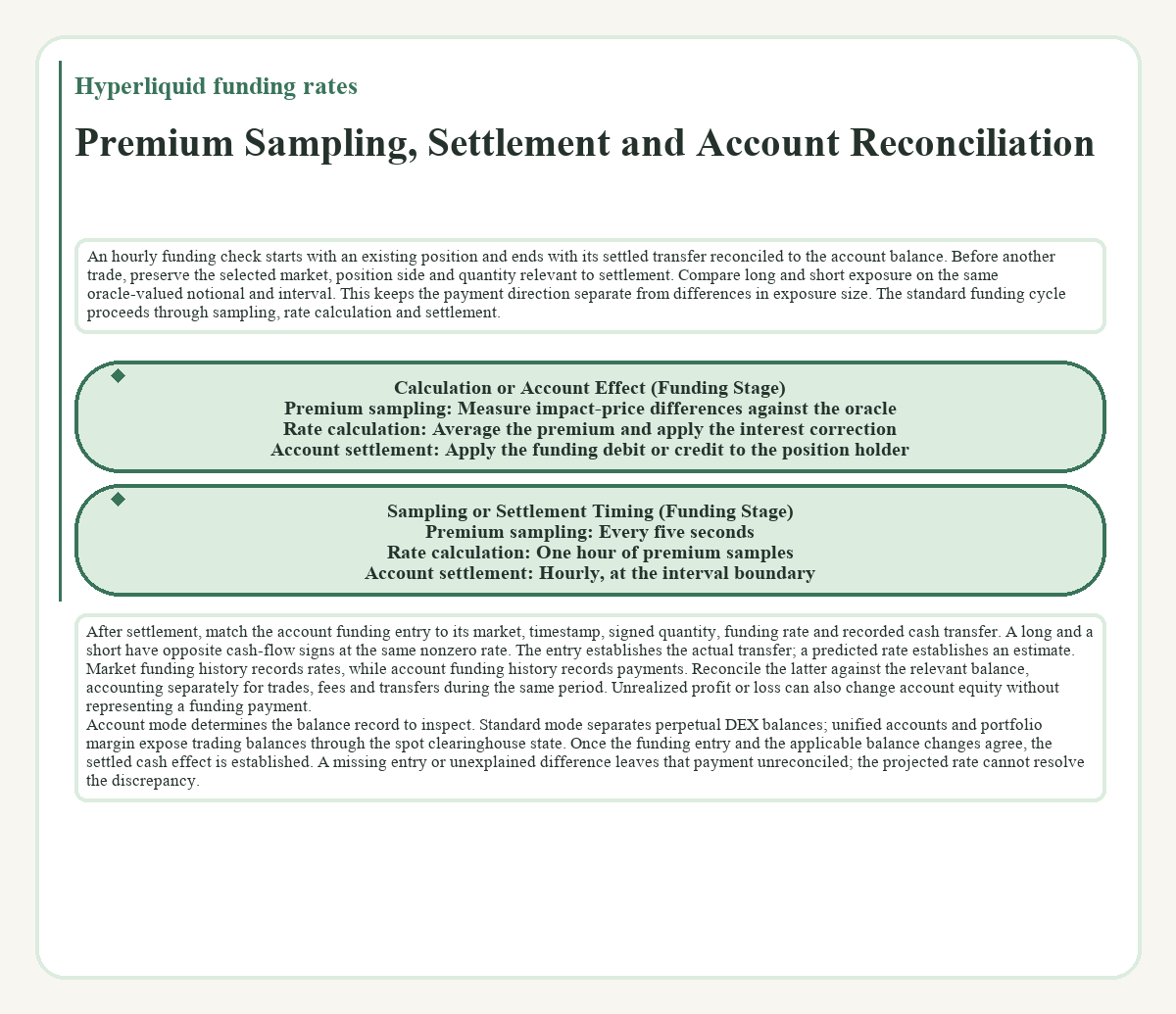
An hourly funding check starts with an existing position and ends with its settled transfer reconciled to the account balance. Before another trade, preserve the selected market, position side and quantity relevant to settlement. Compare long and short exposure on the same oracle-valued notional and interval. This keeps the payment direction separate from differences in exposure size. The standard funding cycle proceeds through sampling, rate calculation and settlement.
| Funding Stage | Calculation or Account Effect | Sampling or Settlement Timing |
|---|---|---|
| Premium sampling | Measure impact-price differences against the oracle | Every five seconds |
| Rate calculation | Average the premium and apply the interest correction | One hour of premium samples |
| Account settlement | Apply the funding debit or credit to the position holder | Hourly, at the interval boundary |
After settlement, match the account funding entry to its market, timestamp, signed quantity, funding rate and recorded cash transfer. A long and a short have opposite cash-flow signs at the same nonzero rate. The entry establishes the actual transfer; a predicted rate establishes an estimate. Market funding history records rates, while account funding history records payments. Reconcile the latter against the relevant balance, accounting separately for trades, fees and transfers during the same period. Unrealized profit or loss can also change account equity without representing a funding payment.
Account mode determines the balance record to inspect. Standard mode separates perpetual DEX balances; unified accounts and portfolio margin expose trading balances through the spot clearinghouse state. Once the funding entry and the applicable balance changes agree, the settled cash effect is established. A missing entry or unexplained difference leaves that payment unreconciled; the projected rate cannot resolve the discrepancy.
Hyperliquid funding rates: what people ask
-
Does an Unfilled Exit Order Stop Funding Charges?
- An unfilled exit order does not reduce the position's funding exposure. The closing order reduces the position only to the extent that it executes. A partial exit leaves the remaining position subject to funding at settlement. Submitting a closing order therefore cannot establish that future funding has stopped.
-
Can a Rising Market Have Negative Funding?
- A rising underlying price can coexist with negative funding because funding reflects the perpetual's relative valuation. The perpetual can trade at a sufficient discount to its reference even while both prices rise. The interest correction and averaging window also affect the final rate. Funding's sign alone does not establish the direction of the next price move.
-
Why Can Funding Remain Positive When the Perpetual Trades Slightly Below Its Oracle Price?
- The standard positive interest component can keep funding positive when the averaged premium is slightly negative. Within the correction band around that interest component, the formula returns the interest component. A momentary discount also does not describe the entire sampling window. Builder-market parameters can differ, so the same observed discount need not produce the same rate across contracts.
-
Are maker Rebates Included in Funding Receipts?
- Maker rebates and funding receipts belong to separate records. A rebate comes from an eligible trade fill, where a negative fee denotes a rebate. Funding comes from holding perpetual exposure at settlement. Receiving both during the same period can increase the account balance through separate contributions; adding them together would obscure the position's actual funding income.
-
What Does an Empty Account funding-history Response Mean?
- An empty account funding-history response does not establish that the market's funding rate was zero. The query must match the account and requested time window, and market rate history is separate from account payment history. Check those inputs and whether exposure existed at settlement before concluding that no funding transfer occurred.
-
How Should a Funding Monitor Handle a WebSocket Reconnection?
- A funding monitor should reconcile the initial snapshot with payments it has already recorded. The userFundings stream sends historical funding payments first, then subsequent hourly updates. The isSnapshot flag identifies the initial data. Counting those records again would inflate received or paid funding. Account funding history can supply records for a gap that the monitor still needs to reconcile.
-
When Do Inclusive Time Windows Duplicate Funding Records?
- Adjacent funding-history queries can repeat a boundary record when both include its timestamp. The API accepts start and end times in milliseconds and includes both boundaries. Preserve millisecond precision when exporting records. For ranges exceeding the API's response limit, query again from the last returned timestamp and remove overlapping records before summing transfers. A repeated row from overlapping queries does not represent an additional payment.
-
Will a Funding Credit Raise Withdrawable Collateral by the Same Amount?
- A funding credit does not establish an equal increase in withdrawable collateral. Open positions still impose margin requirements, and removing margin must satisfy the applicable transfer constraints. Price movements and other account activity can also change the amount available. The credited funding entry confirms the transfer, while the account's withdrawable balance determines what collateral can leave.